Keepers

Death is not the opposite of life. Life has no opposite. The opposite of death is birth. Life is eternal… Death is a stripping away of all that is not you. The secret of life is to “die before you die” and find that there is no death. –Eckhart Tolle

Today I’m thinking about what we keep. I got a new phone last month and found out that my saved voicemails wouldn’t carry over to the new phone. I had a Valentine’s Day message from my Pop on there, and I knew it would be the last one. Every twenty-one days Verizon would prompt me to save that message, but I never could hit the number 7 to delete it. I would listen, think maybe I could just keep it in my memory, then I’d tear up and realize: no. I need that message.

I held the phone up to my computer and recorded that voicemail and you can hear that keeper right here:

(My audio upload skills need improvement. Feel free to offer advice!)

I try not to be too much of a pack rat, but cards and letters are some of the things I just can’t get rid of. These handwritten time capsules have become even more valuable lately, as their frequency decreases with the increase of digital messaging.

Two good friends and wonderful women own a store in Missoula called Noteworthy* Paper + Press, and I encourage you to visit their gorgeous shop, spend the four dollars, and send someone you love a keeper. I doubt you’ll regret it. Visit them here:

http://www.noteworthystore.com/

My Pop died today, eight months after he left that message for me. He wanted me to remember his voice strong, but because he’d lost most of his energy he was unable to make another call. He was simply too weak and emotional to call, but really he was too weak to pretend everything was okay. He would never want me to worry about him.

My poppy was a very proud man, and although I’ve wanted to visit him over the past six months that he was on his slow, downhill slide, I respected his wishes and didn’t go. I decided last week that it was time. It was time for me to see him, and at the very least it was time I visit with my mom and Mimi, maybe get them to laugh a little.

Every time my mom asked my pop if he wanted me to visit he made a gesture to indicate clearly that he did not. When she told him I was coming he cried, and a few days later he let go and passed on. Yes, I’m sad I won’t get to hold his hand again, kiss him on his smooth forehead, listen to his wonderful stories, and assure him that I’m taking good care of myself. But that wasn’t what he wanted, and the old guy got his way until the very end. God Bless Him.

I know it wasn’t because he didn’t want to see me, but rather because he didn’t want me to see him. Not in his weakened state. And who could blame him? That’s the problem with all of us who are afraid to expose our vulnerability, our frailties, our faults. Why?

This needs to stop. We all need to be a little braver about exposing who we are, both the good and the not-so-good. There really isn’t any bad; don’t let anyone convince you there is. I know how I feel when someone is vulnerable with me. I feel trusted. I don’t think less of them for their risk in being honest, but instead my respect increases exponentially, and I just want to wrap my arms around them. Let’s all just try a little more of it.

As the great Dr. Suess said:

“Be who you are and say what you feel because those who mind don’t matter and those who matter don’t mind.”

I don’t think there’s anything else to say tonight, but I urge you: send cards, leave voicemails, mend fences, say sorry, tell people you love them, hug and kiss, take risks, have no regrets. Be brave.

Break Glass, Insert Mirror

I don’t see this blog as a place to embarrass myself, nor do I see it as a place to air dirty laundry. Rather it is a place for me to risk embarrassment, wear the proverbial stained sweatpants, and practice some good old-fashioned truth telling.

About a month ago and a half ago I was in an ugly place. It wasn’t the worst, and certainly not a hole so deep or dark that I ever believed I couldn’t find my way out. The worst thing about my predicament was that my old ways of finding or fixing my unfortunate situations weren’t working.

I slept, I hiked, I took aromatherapy baths with magazines. I read, I wrote, I broke bread with friends. It all helped, but I needed to tip the scales. I knew I had to look in different places.

I went to pick up a friend—one of the bestest—for a hike, but when she saw the desperation on my face (actually, it was running down my face) she suggested I come in for a cup of tea. “At least sit down for a minute,” she said, and I collapsed in a chair. We sat there for a while and talked, but I needed to get my body moving so we hit our favorite trail. I cried more, and was grateful for this non-judgmental friend. I know I can say anything to her, and I cherish the intrinsic value of this friendship.

I told her I didn’t know what to do. I had started my intensive (three thousand words every day for thirty days) writing project, but I was misdirected. I had too many stories I wanted to tell, but I lacked structure. I’d done this before—wrote furiously, hoping the structure would find itself—and it hadn’t worked. I felt like my past was holding me back, but I couldn’t quite pin it down.

I didn’t mince words: I think I need a Shaman. Because she’s G, she didn’t flinch. We talked about it as if I’d said, “I need a haircut.” We talked about what I was looking for and what I was looking to get rid of.

I was reminded of a friend who, when he was struggling with his addiction issues, contemplated treatment with Ibogaine. Ibogaine is a West African rootbark derivative that has been used for over a thousand years in tribal ceremonies. Before it was discovered (in New Jersey in 1962) that Ibogaine could assist with “addiction interruption” it was used in France to treat depression and fatigue. Ibogaine is a psychoactive substance that neurochemically transports an addict to a physically and psychologically pre-addicted state. As a treatment for addiction it has been purported to lessen withdrawal symptoms significantly and to be “like six months of rehab in forty-eight hours.” My friend was intrigued, yet seriously doubtful that he could “trip his way to sobriety.” Perhaps he was right, but a big “what if” hung like lead in the air. What if it could work?

People who take Ibogaine often report having informative visions that help them get at the root of why they became addicted in the first place. In addition to addiction interruption therapy, Ibogaine can also be used for spiritual or emotional growth.

This was what I was looking for. I don’t struggle with addiction, but I secretly (and now not so secretly) wanted those visions. I wanted to find out what was holding me back. I wanted to know why I kept getting in my own way and how I could put an end to it.

At the end of that walk with G I seriously believed I would find a Shaman with some sort of root concoction and I would undergo a ceremony and have my answers.

My bubble was burst when I went to meet a much more cerebral friend for dinner. I sobbed and sobbed and told him my plan. He’s not particularly effusive, yet he laughed out loud when I told him what I was scheming. I may have used the word exorcism, and definitely should have known better with him as my audience.

“That’s ridiculous,” he said, “All you need to do is tell the truth.” We continued to talk about it for hours, and with his guidance I realized that telling the truth means being authentic. I can tell true stories or fictional stories, but the truth lies in me being true to my emotions, and true to what I believe in, not being afraid of what anyone will think. Then he spoke the magic words, “You don’t need an exorcism, a shaman, or a psychoactive experience. Everything you need is within you.”

And then something completely crazy happened: I believed him.

“Stand up for something or you’ll fall for anything.” is a favorite quote of mine that’s been attributed to many. I first heard it from Edward Abbey, one of my all-time favorite authors, but I’ve heard it has biblical origins, which isn’t surprising as it’s just so fundamental. Or it should be fundamental, yet we’re all constantly struggling to define and defend what we believe in, and we’re all clearly falling for a whole lot of everything when our bases shakes because we’re wavering all to and fro. It can be hard to determine who to align with and who to dodge. It is a daily challenge to know which battles aren’t worth picking, and which are worth every last breath.

Even after I believed my friend I had a strong desire to break something. I didn’t know what; I just wanted to hear glass crash and I wanted to be the force behind it. He asked me if I had anything I wanted to break and I immediately thought of an Andrew Wyeth print that I had hanging in my living room. I bought “Around the Corner” with my husband when we were in Maine at a good friend’s wedding. A bunch of us took a day trip to Monhegan Island, where the artist lived and painted for years. We explored the island and eventually landed at the museum where my husband and I bought “Around the Corner” and “Master Bedroom.”  I was drawn to the melancholy in Wyeth’s paintings, and to the detail in his landscape and physical forms as he infused surrealism into realism. I loved the light and the muted colors.

I remembered that weekend as the last good time my husband and I had before we decided to split.

When we divorced the division of our things was seamless; we didn’t fight over anything. It is probably not a coincidence that I took “Around the Corner” (I was the one leaving our home, the one who thought there was something else around the corner) and he kept “Master Bedroom” which depicts a yellow lab (similar to the dog we had together that he kept) sleeping on his owner’s bed.

I hung that print in every house I lived in for the past eleven years with the exception of the year I was in Honduras. There have been many times I thought it was cursed, that it carried some bad luck associated with the notion of something better being just around the corner.

Over the years I’ve expended a great deal of effort trying to live in the moment, and I suspected many times that the painting prevented me from doing so. That the very fact of it hanging in my space was a barrier to my “being here now.” I was trying to blame a print—not even an actual painting, just a print—for my shortcomings. Then I’d realize that was silly—crazy talk—and I’d keep it hanging. But it kept me wondering.

A couple of times I thought about giving the painting to Goodwill or putting a “free” sign on it in the alley, but then I’d feel guilty. What if it really was haunted and I passed the bad juju onto someone else?  I considered burning it or throwing it over the bridge and into the Clark Fork. But what if a boater or fisherman got cut on the glass? What if, what if, what if. Payback is a bitch, and I didn’t want that karmic load, so the painting remained hanging until that night when I wanted to break something and the only thing I could think of was “Around the Corner” and everything it represented for better and for worse.

My friend and I made a plan to meet for breakfast the next morning and take the painting to a place where I could shoot it with his handgun. The relief was palpable.

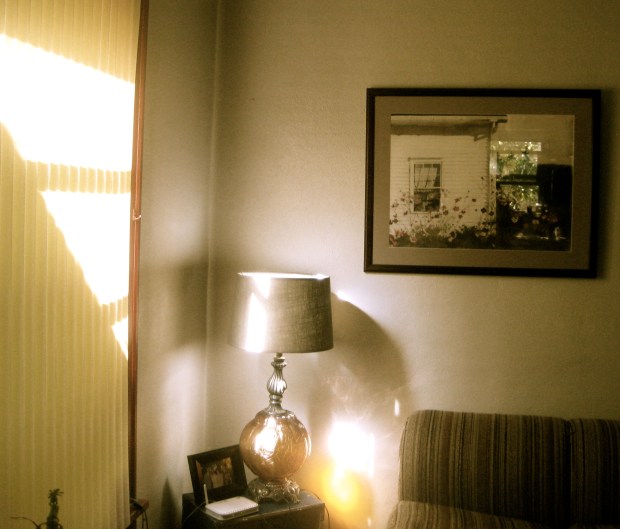
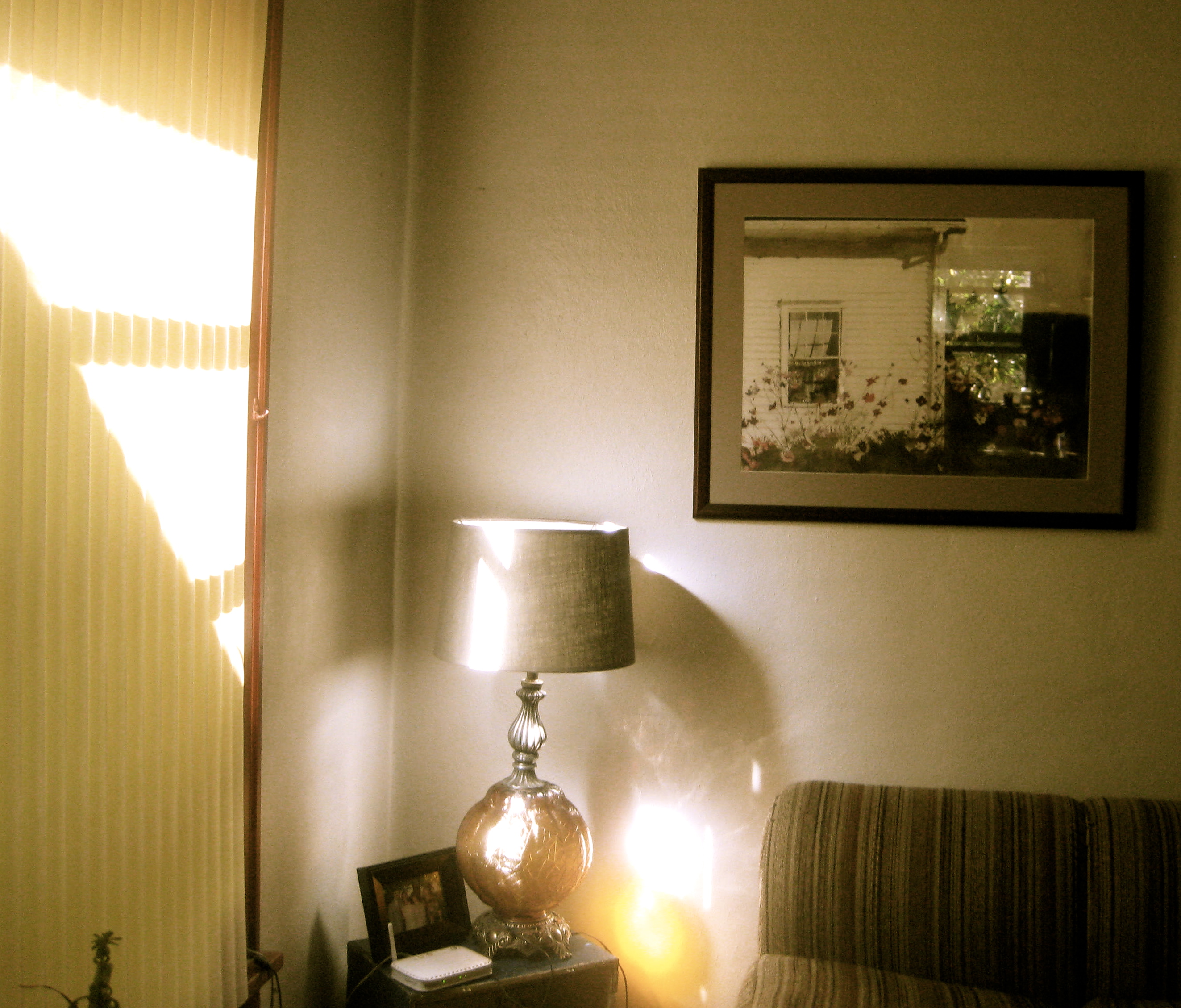
I slept well that night, and in the morning I sat for a while just looking at the painting. The light came through the window and I snapped a couple of shots of it hanging, for the last few moments, in my house. The painting itself isn’t illuminated in this shot, but there’s that awesome, golden orb at the bottom from the sun shining through my seventies lamp. I like the reflection in the glass of the window that was behind me. I like how there’s just a shadow of me.
When we arrived at the shooting area a guy getting into his truck wanted to know what was up with the painting, and I told him in as few words as possible. He didn’t say much, just, “That’s a long time. Probably time to move on.”

I have to say that shooting the painting was awesome, but not as dramatic as I’d hoped. We put dozens of rounds of bullets in it, and the glass cracked and broke, but the scene wouldn’t be described as histrionic. My friend was expecting melodrama from me. He wanted me to scream and yell at the painting. He wanted me to “have words with it,” but I wasn’t feeling it. I didn’t want to be loud. There was no rage in me. I felt peaceful about the ceremony, and parked myself squarely in front of the painting. I stared at it for a few minutes, uncomfortable in my stance. Shifting and squirming and wondering where my words were. I wanted my outside voice to be bold and brave, but instead I quietly said, “Painting, I’m done with you.”
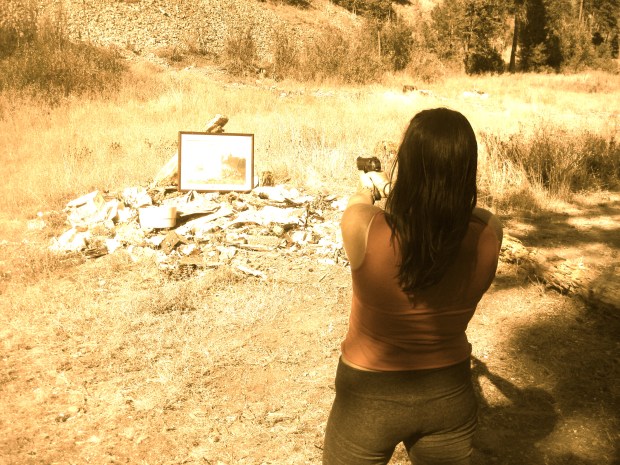
I don’t know what it was all about, but I don’t think I was unable to unleash on the painting because I was embarrassed to do so in front of my friend. I think I was just beyond it. I was all out of fight. I wasn’t holding the print responsible for my searching and yearning. It wasn’t the print’s fault that I made a habit out of looking for something better around the corner or for my discontent when what I found wasn’t what I’d expected.

It wasn’t going to serve a purpose for me to go bananas proving a point. The only point I had to prove was that I wasn’t going to hang something in my house that was a physical reminder of me confusing running away with running towards.

We drove away from the shooting spot. “What are you going to hang there?” my friend asked. I hadn’t given it a thought—was actually looking forward to the white space—but I didn’t miss a beat, “A mirror. I’m going to hang a mirror.”
Lolita was a Slut, King Lear was an Ass, and Mr. Darcy was a Narcissist. (there. i said it.)

Over three hundred (324 to be exact) people have taken a look at this blog since its inception a week ago. Woah. Yes, my mother and close friends account for a lot of those hits, but I’m guessing more than half of those came from my friends sharing, linking, and posting. I think it’s because you believe in me, but I also think it’s because you believe in the message. Thanks.

In addition to starting this blog I’ve done a few new things this week, and have also thought about getting back into some things I used to do.  And I’m not thinking easy or safe things. I’m going to go back to singing lessons.

My friend Alan and I started singing lessons last spring. It was something I’d wanted to do for a while, and so did he, so we teamed up to do it together. I stopped for a whole slew of reasons (I could list them here, but want to avoid this turning into a rant…), but Alan continued his weekly lessons and now, in addition to singing, he’s playing the piano. Go Alan.

We chose Dan Comstock http://www.dcomstock.com/ as our teacher because he came highly recommended, but specifically because I’d heard he can teach anyone—absolutely anyone—how to sing. Dan doesn’t take this as a testament to his skills, but to the fact that really, anyone can sing. We all have a voice and he shows us how to unleash it.

In college a voice teacher told me to “hang it up,” and we spent my lessons driving in my car and singing (I was slightly better there than in her office) and gossiping at Friendly’s over Reese’s Peanut Butter Cup Sundaes. I got full credit for the class and handed out programs at the performance. I felt like a loser. Why couldn’t I sing?

I don’t think I was born with the voice of an angel, but she set me up for failure by picking my song for me. The theme that semester was show tunes, and she chose “I Don’t Know How to Love Him” from Jesus Christ Superstar for me, a beginner. It’s a beautiful song—I can see that now—but I had little chance of being able to hit those high notes (um…the first “love”….I don’t think so.)

The words and the message are beautiful, but I was twenty years old. And Mary Magdalene? I won’t go into a lengthy discourse here about Mary Magdalene, but lets just say that even with the show tunes theme she could have let me sing “Tomorrow” from Annie or “Hopelessly Devoted to You” from Grease. Regardless, it didn’t matter what I sang or didn’t sing. She told me I was a lost cause when it came to singing, and for sixteen years I believed her.

I struggled with writing in high school. I struggled so much that when I got to college I had to take a somewhat remedial Rhetoric class to help me learn how to express myself in writing. I’d fought a losing battle in high school English classes, unsure of how to regurgitate in writing what the teacher talked about in class. I didn’t understand the point, wondered why my opinion didn’t count.  What if I though Lolita was a slut? What if I thought King Lear was an ass? What if I thought Mr. Darcy was a narcissist? Didn’t matter.

In the college Rhetoric class I was finally able to have an opinion, and it turned out my writing, when I could put an “I” in my essays—wasn’t half bad. It turned out I had a voice, it just needed an appropriate venue.

So I’ll go back to singing, and learning to use that voice will no doubt support my other voice, my current writing endeavors. Doing what scares you will take you to the next dot on your personal map; being afraid to make the next dot will lead you to burning a hole in your plan. My favorite Steve Jobs’ quote lately:

“…you can’t connect the dots looking forward; you can only connect them looking backwards. So you have to trust that the dots will somehow connect in your future.”

What do you do that scares you? What would you like to do that you think you can’t? Do you think you can’t run a mile? Go to graduate school? Learn a foreign language? Take a solo road trip? Bake a cake? Cook dinner for twenty? Have a dog? Love someone? How are you connecting your dots?

“I Have a Story”

I published my first short story. Finally. I finally accepted the reality that you have to submit to get in print, and starting small isn’t necessarily a bad thing. I may get “the big book deal” some day, and I may not. But you have to start somewhere, and start I did.

I’m excited but scared. What if something happens? What if nothing happens? But seriously. I’m not going to “what if” myself into hiding under the bed.

What’s done is done, so I’ll exchange what IF for what IS.

I submitted this story on a whim to SPLIT Quarterly. I heard about this new journal, saw that they were accepting submission, and I clicked the link. I appreciate their mission statement, in particular that last statement:

SPLIT is an experiment in digital publishing designed to showcase emerging talent in the art of storytelling. We are focused on the advancement of the literary arts and seek to break the predictable trends of traditional publishing. It is said that in order to actualize change, a split from routine must be in order.

Right? Right.

The email from SPLIT arrived on a day that simply didn’t have any room in it for a rejection. I had about an hour before work and considered not opening it until I was back home, but knew I’d made it through long workdays smiling and mostly intact (see below re: pretending.) in the wake of bigger rejections and weightier upsets. I could do this, I reasoned, but I wasn’t sure. That day and week were altogether different; I was seriously worried I’d found my tipping point.

But that’s just not my style, so I said “what the hell?” and clicked on the email. The editor thanked me for the submission blah-blah-blah and after careful consideration blah-blah-blah. I read it three times before I figured out they wanted to publish the story. And just like that the day turned around.

The character in “I Have a Story” is doing something most readers can’t relate to, yet the emotions she feels are universal. But I don’t want to sum it up too much for you, why don’t you just let me know what you think. {please….} And tell your friends. {please…}

You can read the short story here: http://splitquarterly.com/

“Mean”

My heart breaks for all the kids who are bullied in schools, on sports fields and at home. Why are people mean? I love this song and the video rules. Good on ya, Taylor Swift.

This is what she has to say about her song “Mean”: “There’s constructive criticism, there’s professional criticism, and then there’s just being mean. And there’s a line that you cross when you just start to attack everything about a person… This happens no matter what you do, no matter how old you are, no matter what your job is, no matter what your place is in life, there’s always gonna be someone who’s just mean to you. And dealing with that is all that you can control, how you handle it. This song is about how I handle it.”

I hope kids (and adults) are inspired by its message to worry less about what people think of them, realizing that how people treat you says more about them than it does you. If nothing else I hope this song makes people smile and dance like fools in their kitchens. That’s what I’m doing.

Be yourself; Everyone Else is Already Taken.

What’s been on my mind lately is how we all make conscious and subconscious decisions about what we reveal to people and what we hide. Many of us are scared to be ourselves and rightfully so; we’re a judgmental lot.

I chose this title—SORRY I’M NOT WHO YOU THOUGHT I WAS—because even when we’re not saying it out loud, I think it’s what many of us feel when we’ve disappointed someone. But the “sorry” is propped up with an {ughhhhh} and the dissatisfaction is in place, firmly rooted, not going anywhere. What originated as an expectation becomes a resentment.

But who exactly are we disappointing? Is it really the other person, or are we disappointing ourselves because we haven’t been genuine and authentic? It is exhausting work to try to be who someone else wants you to be. Attempting to figure out what or who someone wants you to be and then to try to fit the ideal is a slippery slope at best.

Maybe it’s because we haven’t been honest about our capabilities and limitations, or maybe we haven’t been honest about our truth, our shortcomings, and our darker sides. But it doesn’t have to be so dire. Have you ever just felt like you’re pretending?

The best solution to any and all of this is, in the words of Oscar Wilde: Be yourself; everyone else is already taken. But reality is tough business, and I think we’ve all pretended to be something we’re not. A better daughter. A devoted employee. A fair employer. A faithful spouse. A good neighbor. A trusted confidante. An impartial judge. A loyal friend. A badass skier. A victim. A hero. And I ask you this question for the sake of the conversation: what have you pretended?